Danjugan Island
Danjugan Island
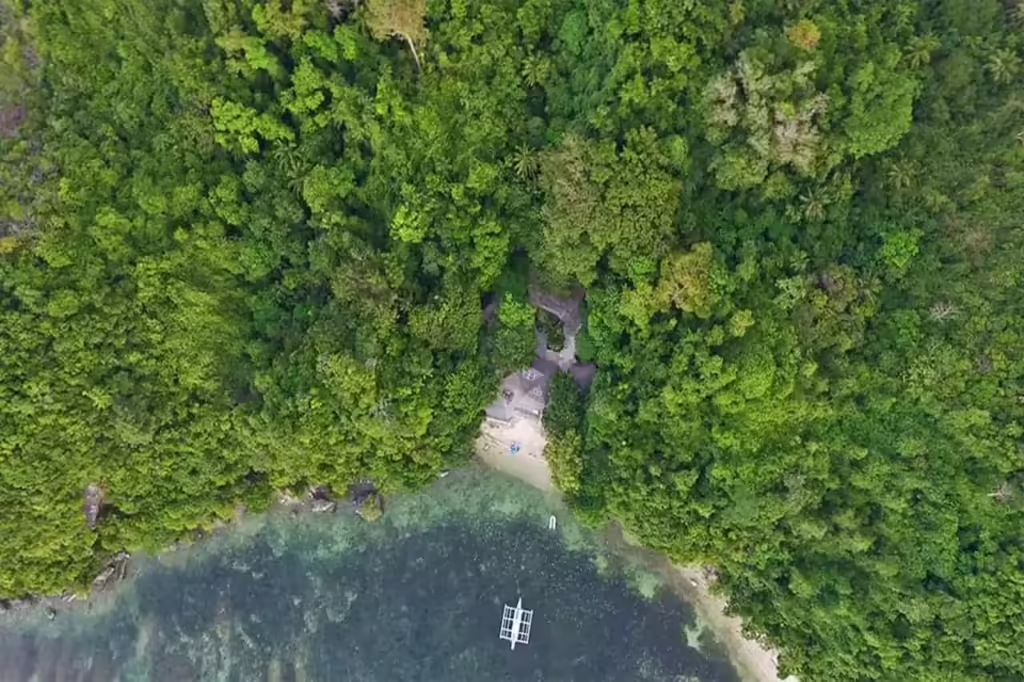
Some destinations take days to reach. Danjugan is not one of them — you can see it from the beach at Amila, a low, forested island about three kilometres offshore, wrapped in reef and ringed by water that turns from jade to deep blue.
What is Danjugan Island?
Danjugan Island is a 43-hectare marine reserve and wildlife sanctuary off Brgy. Bulata, Cauayan, in southern Negros Occidental, Philippines. It is owned and managed by the non-profit Philippine Reef and Rainforest Conservation Foundation (PRRCFI).
The island holds five lagoons, limestone and mangrove forests, bat caves and fringing coral reefs. Sanctuary surveys have recorded more than 570 fish species, over 240 hard corals and more than 70 bird species, and its beaches are a nesting site for hawksbill and green sea turtles. Visitor numbers are deliberately limited under a low-impact ecotourism programme.
Danjugan lies about three kilometres offshore from Amila Dive Beach Resort — roughly a 20–30 minute boat ride — which makes the resort a natural base for a guided day trip.
Danjugan Island at a glance
| Type | Marine reserve & wildlife sanctuary (privately managed, non-profit) |
| Location | Off Brgy. Bulata, Cauayan, Negros Occidental, Philippines |
| Size | 43 hectares |
| Managed by | Philippine Reef & Rainforest Conservation Foundation (PRRCFI) |
| Landscape | 5 lagoons, white-sand beaches, bat caves, limestone & mangrove forest, seagrass beds, fringing coral reefs |
| Recorded biodiversity | 244 hard-coral, 579 fish, 72 bird, 10 bat, 17 mangrove & 8 seagrass species (7 ecosystems) |
| Protection | 3 no-take marine zones, established 2000 (Cauayan Municipal Ordinance 99-52) |
| Sea turtles | Hawksbill & green turtles nest on the island (rainy season) |
| From Amila resort | ~3 km offshore, ~20–30 min by boat |
| How to visit | Guided day trip, arranged through Amila reservations; advance booking required |
One of the Philippines’ best-protected islands, on Amila’s doorstep
That closeness is deceptive. For all its proximity to the mainland, Danjugan is one of the most intact marine sanctuaries in the country — and that is by design, not luck.
At just 43 hectares, the island shows what a reef and forest can become when they are largely left alone. It is owned and run not by a hotel group but by a conservation non-profit, the Philippine Reef and Rainforest Conservation Foundation (PRRCFI). Their model is deliberately low-impact and low-volume: few guided visitors, firm rules, and fees that help fund the island’s protection.
The result feels genuinely wild — reefs thick with fish, forest loud with birds, beaches where turtles still nest. For guests at Amila, it is the most rewarding day out in the area, and the resort sits directly across the water to make it easy.
Where Danjugan Island is — and how to get there
Danjugan lies off the southwest coast of Negros Occidental, near Cauayan and Sipalay, in the Sulu Sea. The nearest mainland point is Brgy. Bulata — the same barangay as Amila Dive Beach Resort. From the resort, the island is a 20 to 30 minute boat ride, depending on the sea. It sits about three kilometres offshore, and access is by guided day trip, booked ahead.
Reaching this coast is straightforward. Most visitors fly into Bacolod–Silay Airport, the main gateway to Negros Occidental. From Bacolod City, the coastal drive south to Bulata is about 90 kilometres — roughly three to four hours by car or bus. Travellers from the far side of the island can route through Dumaguete. Our Travel to Amila page covers every option in detail.
One thing to know: Danjugan is a protected sanctuary, not a public beach. You cannot simply land by boat. Visits are booked in advance and guided — which is exactly what keeps the island worth visiting. Staying at Amila removes the logistics; our reservations team arranges the permits and boat around your stay.
Marine life: what you’ll see, and why it’s different here
The reefs around Danjugan are unusually alive — and that is not an accident.
Three permanent no-take zones, where no fishing of any kind is allowed, have surrounded the island since 2000. Protection like that changes a reef in ways divers can see. When fish are not caught, more of them survive to grow large — and large fish matter out of proportion to their size, because a big female can produce many times more eggs than a small one. Those eggs and young then drift into the surrounding water, seeding reefs well beyond the sanctuary’s edge.
The effects compound. Plant-eating fish keep algae in check, so corals aren’t smothered and can grow. Predators stay in the food web, keeping the whole system in balance. A protected reef, in short, is not just prettier — it is healthier, more productive and more resilient to stress. That is the general principle behind marine protection everywhere, and Danjugan is a working example of it: the sanctuary’s own surveys record 244 species of hard coral and 579 species of fish around this one small island, alongside seagrass beds and mangroves that nurse the next generation.
For a diver or snorkeller, the difference is felt before it is understood. Fish are more numerous and noticeably less skittish. Coral cover is dense and actively growing. The reef simply feels busy in a way unprotected sites nearby often do not. On the reefs and dive sites you can expect to encounter:
- Sea turtles — hawksbill and green turtles feed in the surrounding waters, and the island is a genuine nesting site.
- Reef fish in numbers — schooling fusiliers, snappers and the dense small-fish life that only healthy coral supports.
- Macro life — frogfish, nudibranchs, pipefish, moray eels and octopus, for those who look slowly and closely.
- Corals — vibrant soft corals and healthy hard-coral gardens across the fringing reef.
- Occasionally reef sharks and other larger visitors — never guaranteed, which is exactly how a wild reef behaves.
The reefs suit everyone from first-time snorkellers to experienced divers, with sites matched to the day’s conditions. Our dive team knows this water intimately. You can see the wider area’s named sites — including Mad Max (Bulata Pier), a former mining pier turned macro haven minutes from the resort — on our Dive Sites page, and go deeper on the region’s marine life and our diving pages.
“We look across at Danjugan every morning, and it still surprises us. What guests remember most isn’t one big dramatic sighting — it’s how busy the reef feels compared to unprotected water: fish that don’t scatter, coral that’s actually growing, the quiet when you surface and there’s simply no one else around. Bring a little patience for the macro life and let the guides slow you down. That’s when Danjugan gives you its best.”
— The Amila dive team
Wildlife: the island above the water
Call Danjugan a marine sanctuary and you describe only half of it. The island itself is a compact wilderness — limestone forest, mangrove and five linked lagoons — holding a density of land wildlife that has largely disappeared from the developed mainland. Across seven ecosystems, the sanctuary has recorded 72 bird species, 10 kinds of bats, 17 mangroves and eight seagrasses.
Birds are a quiet headline. A nesting pair of white-bellied sea eagles has long held territory here — the lookout called the Eagle’s Nest is named for them — and the forest shelters rare pigeons and doves. The island’s most unusual resident is the Tabon scrubfowl, a chicken-sized megapode that incubates its eggs in warm sand; Tabon Beach carries its name.
At dusk, the island belongs to its bats. Danjugan’s caves and forest support both fruit bats and insect-eaters, and watching fruit bats stream out to feed is one of the island’s memorable sights. On land you may also meet coconut crabs — the largest land-living arthropod on Earth — along with butterflies, reptiles and the small forest life that thrives where habitat stays intact.
Where to see Danjugan’s wildlife
| Where on the island | What you may see | Note |
|---|---|---|
| The reef & lagoons | Sea turtles, reef fish, coral | Guided snorkel from a platform |
| Eagle’s Nest (lookout) | White-bellied sea eagles | Nesting pair; named for them |
| Tabon Beach | Tabon scrubfowl (megapode) | Ground-nesting bird |
| Turtle Beach | Turtle nesting (seasonal) | Rainy season; sanctuary-managed |
| Caves & forest | Fruit & insect bats, coconut crabs | Best at dusk, with a guide |
The forest trails and lagoons are where it all comes together, always with a sanctuary guide to show you what an untrained eye would miss.
Conservation: why Danjugan is protected, and what that means for you
Danjugan is protected today because, a generation ago, it nearly wasn’t.
In the late twentieth century the island and its reefs faced the pressures common across the region — overfishing, blast fishing, habitat loss. The Philippine Reef and Rainforest Conservation Foundation was formed to turn that around, securing the island and working with the local community and municipality to protect the water around it.
In 2000, three no-take zones were formally established around the island through Cauayan Municipal Ordinance 99-52. In the years that followed, the reefs recovered, fish populations rebuilt, and Danjugan became a working model of community-backed marine protection. Today it operates as a centre for conservation, education, research and sustainable local livelihoods — not as a conventional resort.
For visitors, that history shapes the day in specific, deliberate ways:
- Numbers are limited. The programme is intentionally low-volume, so the island never feels crowded — but visits must be booked ahead.
- You snorkel from a platform, not off the beach. To protect fragile shallow coral, snorkellers are taken out to a platform rather than wading in from shore.
- Nothing is collected or disturbed. No taking shells or coral, no touching marine life, no feeding wildlife.
- Your visit funds protection. As a non-profit island, fees go directly to conservation, the people who guard it, and community and education work.
It is a rare thing to watch conservation actually work, and rarer still to take part simply by visiting well. Amila shares that outlook: as a small, DOT-accredited boutique dive resort, our focus is responsible diving and low-impact time in the water around Bulata — which is why a day at Danjugan sits so naturally alongside a stay with us.
Planning your visit
A trip to Danjugan is a guided day out rather than an independent excursion, and a little planning makes it run smoothly.
How to book
The simplest route for resort guests is to let Amila’s reservations team arrange your visit. Because the sanctuary must process permits and insurance for every visitor, trips need to be booked in advance — the sanctuary asks for reservations to be made at least three days ahead. Tell us during your stay, or when you book your room, that you would like to visit Danjugan, and we will confirm the timing and current arrangements. For the current tour rate, please ask reservations directly, as prices are set per the programme and can change.
What a visit typically includes
A guided Danjugan programme is built around the island’s ecosystems rather than a beach day. Depending on the option you choose, a visit generally combines guided snorkelling over the reef (from the platform), time to take in the lagoons and beaches, and a guided forest or wildlife walk with an island interpreter. Snorkelling gear is provided as part of the sanctuary’s guided programme. The emphasis throughout is on learning about the island as you experience it.
What to bring
Pack light but sensibly: reef-safe sunscreen, a hat and sun protection, water, and a dry bag for anything that must stay dry on the boat. Bring a swimsuit and a towel, sturdy sandals or trail shoes for the forest paths, and a camera. Leave behind anything single-use where you can — the island’s low-waste ethos is part of the experience — and follow your guide’s instructions at all times.
Who it suits
Danjugan rewards travellers who come for nature rather than nightlife: divers and snorkellers, birdwatchers, families with curious children, couples and solo travellers who value quiet, protected places. It pairs especially well with a dive-focused stay at Amila. If you are weighing up the wider area, our Discover Sipalay page sets out what else the coast offers, from Sugar Beach to island-hopping and diving.
Diving and snorkelling around Danjugan
You do not need to be a certified diver to enjoy Danjugan’s underwater life — the reef’s shallow areas offer excellent snorkelling, and colourful fish and coral sit only a short distance beneath the surface. For certified divers, the reefs and dive sites around the island are among the most rewarding in southern Negros, with sites to suit different certification levels and sea conditions.
Amila runs a full dive operation, so a Danjugan reef day can slot into a broader diving itinerary. Whether you are looking to try scuba for the first time, work through a PADI course, or simply log good dives on a healthy reef, our Scuba Diving pages cover the options, and the Dive Sites page lists the wider area’s sites. As always, our team recommends the best dives based on the day’s conditions.
The best time to visit
Danjugan can be visited year-round, but sea conditions — and therefore underwater visibility — vary with the seasons, and a couple of natural events are worth timing around.
| Season | What to expect |
|---|---|
| November – May | Calmer seas, clearest visibility — prime diving and snorkelling |
| June – October | Still enjoyable diving; more changeable conditions |
| Rainy season | Hawksbill & green turtle nesting (never guaranteed; check with the foundation) |
As a general guide, and consistent with our own experience of these waters, November to May tends to bring calmer seas and the clearest visibility. June to October can still offer very enjoyable diving depending on the weather. Because our dive team is on the water daily, the most reliable forecast is simply to ask them close to your dates. One seasonal highlight runs against the calmer-season logic: sea turtle nesting on the island’s Turtle Beach happens during the rainy season. Turtle nesting is a sensitive, protected event managed entirely by the sanctuary — never a guaranteed part of a visit — so if you hope to time a trip around it, check directly with the foundation.
Your Danjugan questions answered
Have a practical question about visiting — what to bring, whether you need to dive, how booking works? You’ll find answers on our frequently asked questions page, and our reservations team is always happy to help directly.
Make Amila your base for Danjugan
Amila Dive Beach Resort is a small, family-run boutique dive resort on the beach in Brgy. Bulata — directly across the water from Danjugan Island, and the natural starting point for a trip. Guests enjoy comfortable rooms with garden and sea views, fresh local and international cooking at our restaurant, a full dive centre, and a genuinely quiet stretch of coast. Because we are so close to the island, we can help arrange your Danjugan day around the rest of your stay, whether that is diving, snorkelling or simply slowing down.
Ready to plan your visit? Contact our reservations team to check room availability and arrange a guided Danjugan Island trip during your stay.